AI-Native Senior Product Designer · Designed and shipped solo · Financial Finesse · 2026
I designed and shipped the AI studio that took our content library into 28 locales — solo, in four weeks, with the architecture, the tradeoffs, and what broke written down.
Financial Finesse's people were quietly using their own unregulated AI subscriptions to write company content. I built one tool, grounded in our voice pillars and compliance rules, that replaced all of it, then turned it into a localization engine that rewrites an article for any market. TypeScript and Lit, a Cloudflare Worker, the Anthropic API, 221 tests. In production today.
The team was writing company content on scattered, unregulated AI subscriptions, and the company had decided to go global. I designed and shipped Global Content Studio: one grounded AI studio with an 8-step localization pipeline, Atlas, and a human localizer between the model and the member. Solo, first commit to launch QA in four weeks. It holds 8,118 localized variants across 28 locales today; one four-day run localized 3,512 pieces and brought ten locales live.
- Role
- AI-Native Senior Product Designer · designed & built solo
- Timeline
- First commit Apr 28, 2026 · launch QA May 22 · first ten-locale run Jun 1–4
- Team
- Solo (493 of 524 commits); one engineer, 20 commits
- Scope
- Strategy · UX/UI · Grounding and guardrails · Build · Pipeline
Strategy, design, grounding, and the build — end to end
Spotted the risk in the team's scattered, unregulated AI and defined the product — then saw where the company was headed and pivoted it from a writing tool into a localization engine.
UX, UI, and the authoring workflow — from a single prompt to a compliance-checked, localized asset, one country at a time or in bulk.
Wrote the voice pillars, compliance rules, and the per-country wiki the model is grounded on — the source-of-truth layer that keeps a general model inside Financial Finesse's facts. Nothing is trained; everything is prompted, retrieved, and checked.
The whole app: the TypeScript and Lit front end, the Cloudflare Worker and its Azure Blob client, the pipeline, the CLI workflow, and 221 Vitest tests. 493 of the repo's 524 commits are mine. First working version in about two weeks; launch QA at week four.
Nothing in the Studio itself. One engineer contributed 20 commits of integration and review. The localizer review console that reads the Studio's output lives in a sibling repo, where I also ship the Python review API and the React console.
Designed Atlas and the human-in-the-loop review that lets it run at scale. In production: 8,118 localized variants across 28 locales, 4,154 published, 975 approved, 2,772 in review.
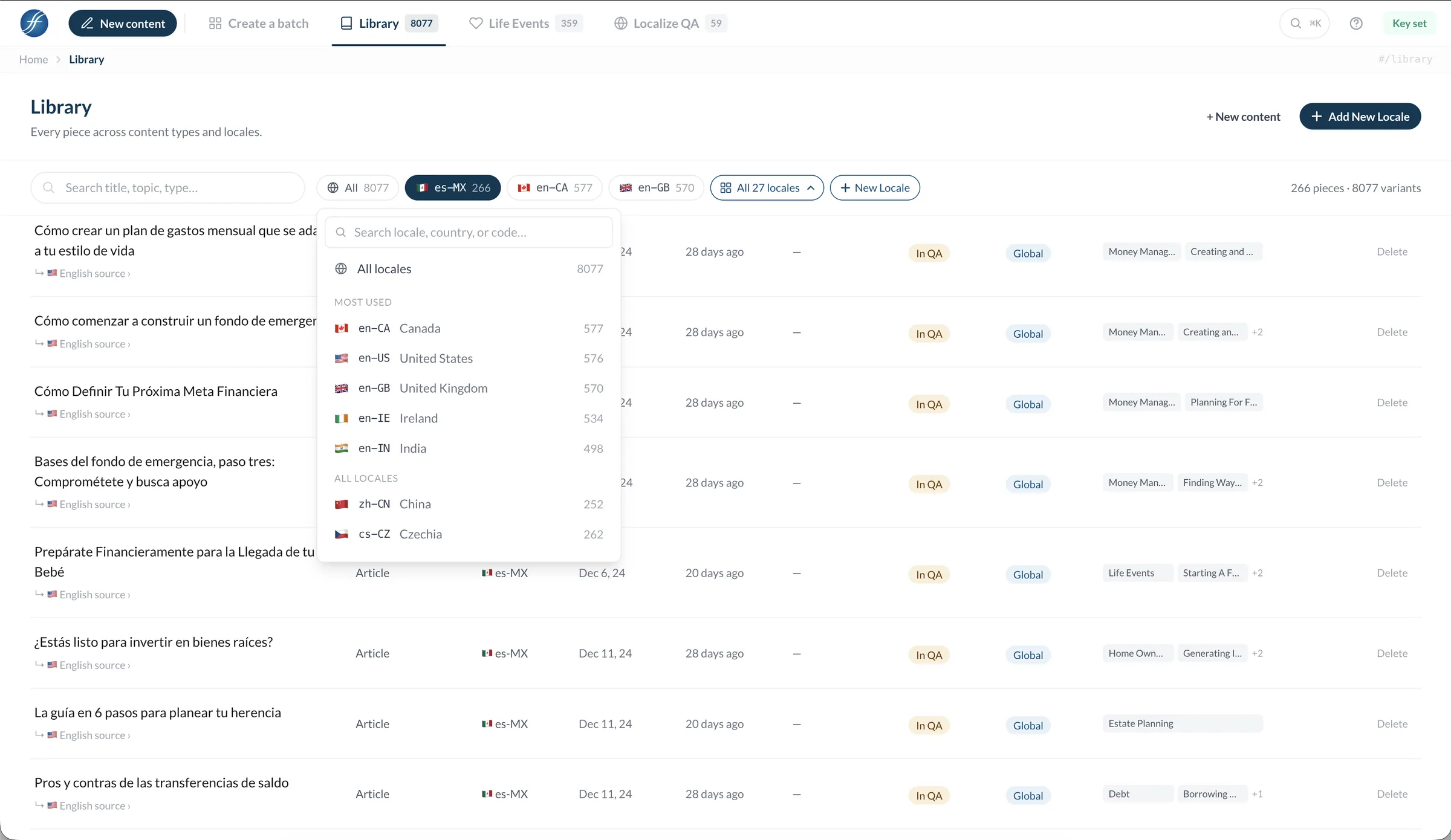
Everyone had an AI tool. None of them sounded like us — and then we decided to go global.
Last year, AI went from novelty to daily habit across the company. Most of the team reached for it to write and edit content — each on their own paid subscription, each with no guardrails. The output was fast, but it didn't sound like Financial Finesse, and we had no way to regulate what any of it said. In a business built on financial trust, that's a real risk.
Then the company set its sights on every market. Localizing our library the traditional way would have meant hiring one in-country specialist per market, then having each of them translate, culturally adapt, and QA every single item — slow, expensive, and impossible to scale.
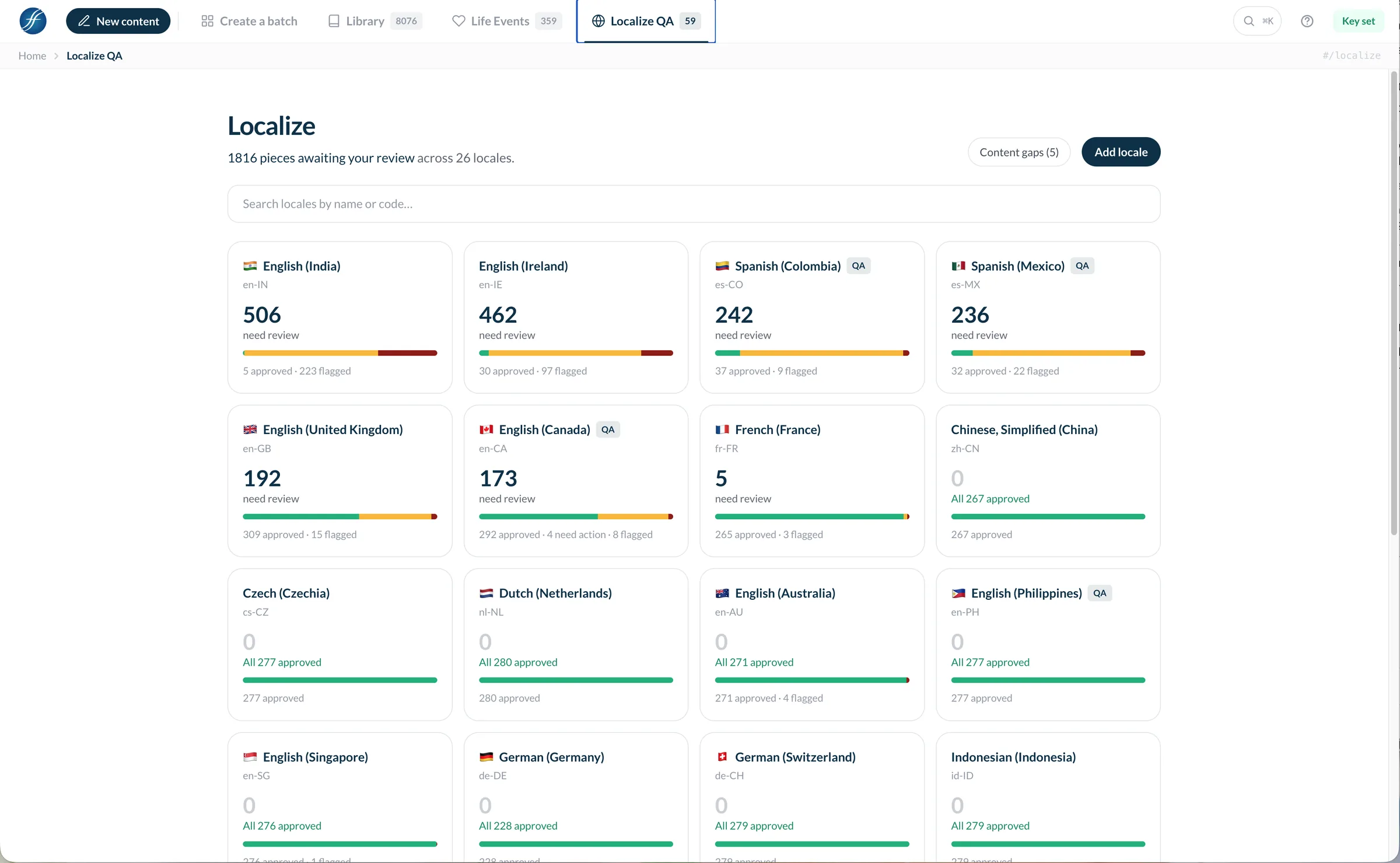
From a writing tool to a localization engine
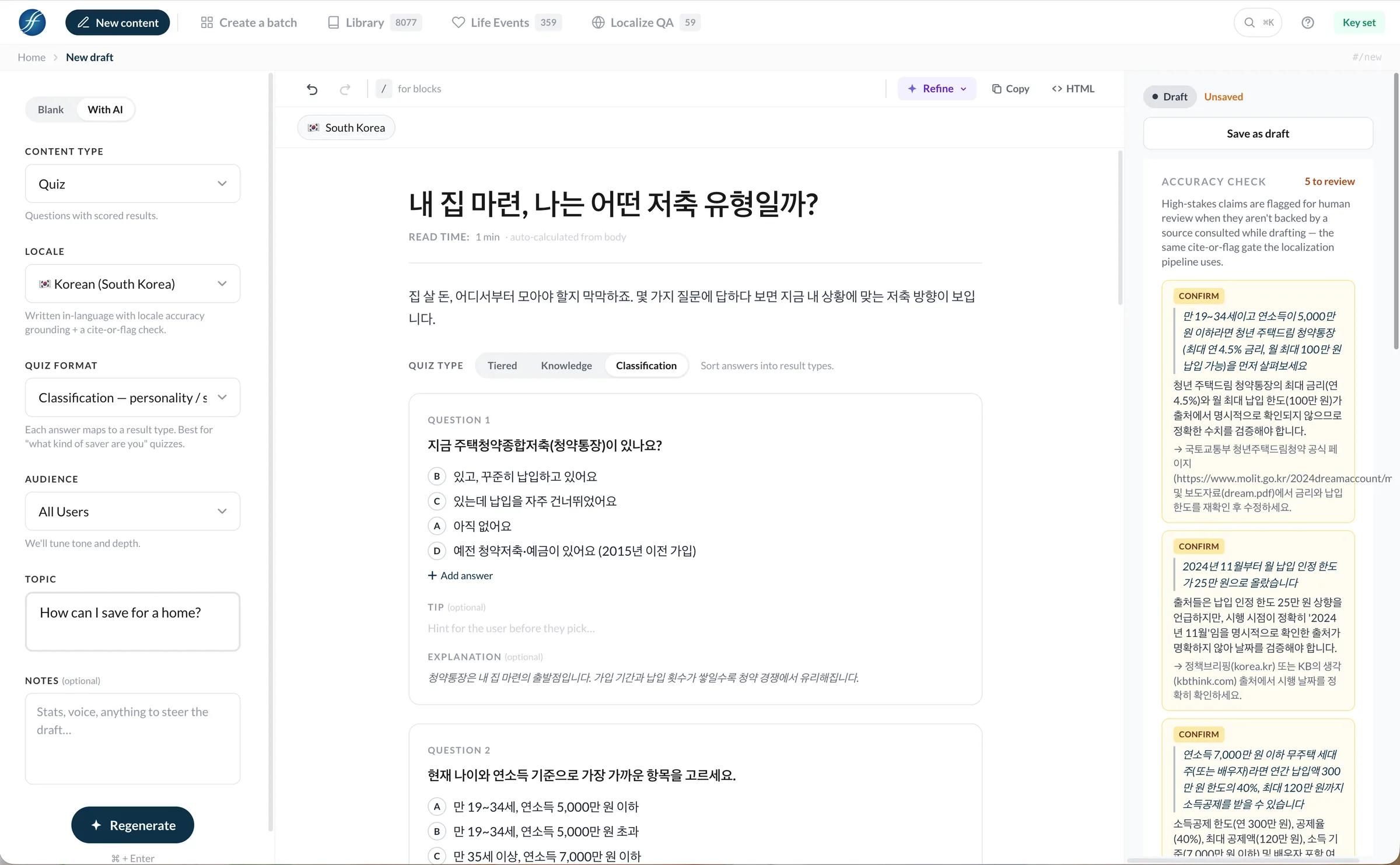
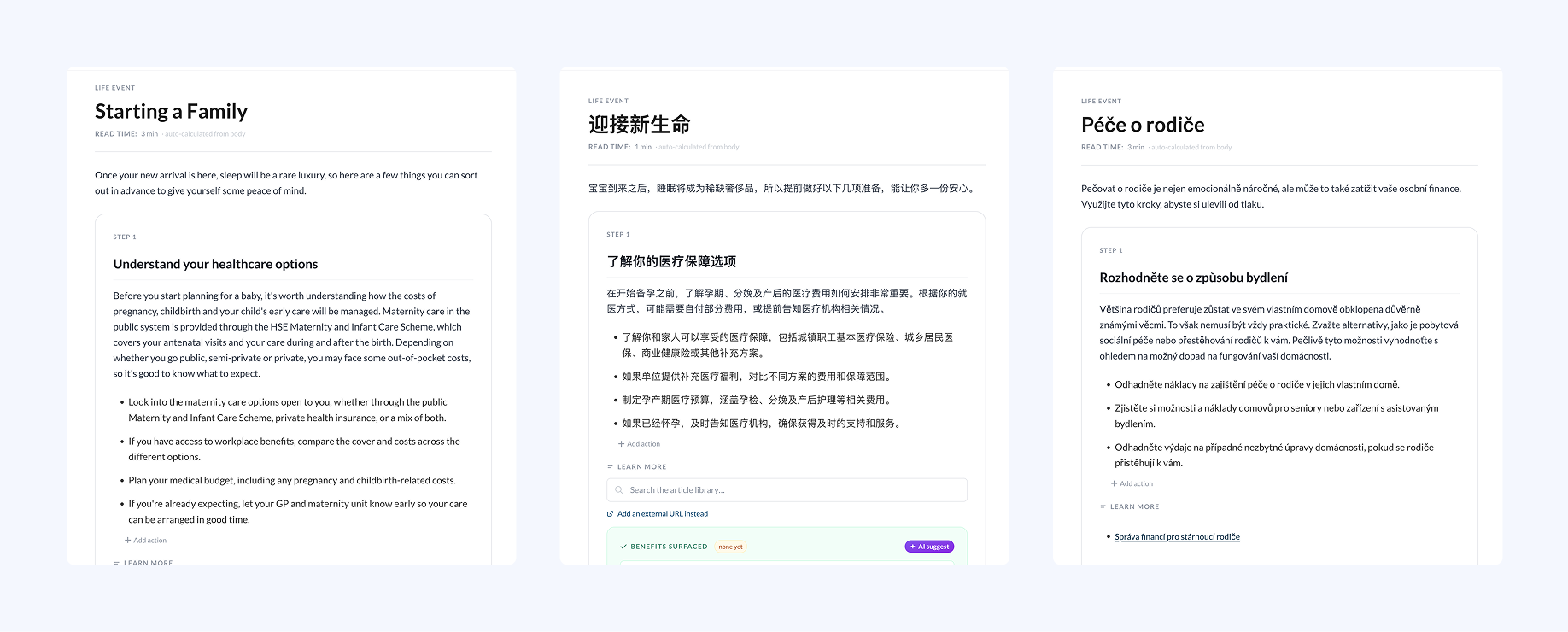
I pivoted the studio from writing content to writing and localizing it. It can take an existing article or write a brand-new one, then adapt it for any country in the world — one at a time or in bulk. Not a translation. A rewrite in the correct tone, financial structure, customs, and culture.
Grounded, not trained. Every request carries Financial Finesse's voice pillars, compliance rules, and content schemas, and runs through the Anthropic API behind a Worker. Drafts come back sounding like us because the prompt and the retrieved facts say so, not because a model was fine-tuned.
A per-locale wiki as the source of truth. For each market, a curated knowledge base the model reads from instead of the open web: the tax authority, the retirement system, the programs a reader can actually use. That is what makes a localization accurate instead of a guess.
True localization, checked, not just scored. Each output is rewritten for tone, financial structure, customs, and culture. The model rates its own confidence per pass and tags every local fact high, medium, or low; anything below high is flagged for the reviewer. Then an independent verify pass reads the draft the way a native reader would and returns pass or fail with typed problems, and a redo loop runs before a human ever sees it. The score is a routing signal. The verify pass and the localizer are the gate.
Human in the loop, always. Nothing auto-publishes; the policy is in the code. Every variant lands in review, a localizer approves it, and approved articles are never overwritten by a later run unless someone asks.
Four parts, one secret-holder
The browser never sees a key. A static TypeScript and Lit app on Vercel talks to one Cloudflare Worker, and the Worker is the only thing that holds the Anthropic key and the Azure connection string. It proxies model calls and exposes a small REST surface over Azure Blob Storage, where every entry, localized variant, per-locale wiki page, and QA flag lives. Bulk localization runs from a CLI workflow that fans out one model call per stage per article and writes back through the same Worker, so the app and the pipeline share one source of truth and one write path.
Inside Atlas — what happens to every article
Every article moves through Atlas, an 8-step pipeline — whether it's brand-new or being localized. It starts with a fit check that decides whether the piece even belongs in that market (if it's built around something that doesn't exist there, we don't localize it), then runs eight controlled steps. The model's confidence is carried through every step as a routing signal, never as a guarantee: the fit check, the independent verify pass, and a human localizer are what decide whether anything publishes.
Hover or tap a step to see what happens and why it matters.
Three calls I would make again
One Worker holds every secret
Not taken: calling the Anthropic API and Azure from the browser, which is faster to build and one less deploy.
Why: a shared key in client code is a leak waiting to happen, and there would be no single place to gate writes. The cost is a second deploy target and a hand-written Azure client, since the SDK cannot run in Workers.
A per-locale wiki instead of open-web search
Not taken: letting the model research each market live on the web at draft time.
Why: financial facts have to be ours. A curated wiki is slower to build, one locale at a time, but every retirement system and tax authority the model cites is something a person vetted. Web search still runs in the research stage; it feeds the wiki, it does not bypass it.
Five model calls per article, not one
Not taken: the original one-pass pipeline, which was a fifth of the cost.
Why: one-pass output kept US framing and US-only links that no automated check could see. Splitting into gate, research, draft, independent verify, and save took an article to roughly 335k tokens, and that cost is what forced the skip-approved default and targeted re-runs instead of full-corpus rewrites.
Five production failures, and the fix for each
5,455 published variants carried English titles and slugs on localized bodies
Found in the live data during an August audit, not by a user. Title and slug localization is now a checked output of the packager, and the review console shows source and localized titles side by side.
US-only links were invisible to every automated check
Localized articles kept first-party links to US-only content: HSAs, 401(k)s. The fix was a new independent verifier stage (a fail on a US-only link forces a redo) plus a deterministic link check that wraps, aligns, or strips links and rewrites the dangling call-to-action sentence. The first full scan found 51 of those across 27 locales and 8,120 variants.
Five different locale briefs for the first five articles of every batch
The 5-worker pool derived the per-locale brief in parallel before the cache was written: five model calls and five inconsistent briefs. The fix is a keyed single-flight lock with its own tests. A cached brief was later caught still using the wrong register, which led to brief versioning.
A pass failed silently and the job sat at "running" forever
The cultural pass threw a JSON parse error that was swallowed. Unparseable model output now fails the job with a retry, and a count check throws rather than saving a partial article.
A batch overwrote articles a localizer had already approved
A 25-article run reported "25 written, 0 errors" while discarding human edits: measured on three reviewed articles, none of the reviewed sentences survived the re-run. Approved variants are now skipped by default; re-localizing one is an explicit flag.
And the fit check, on real data: of 75 en-GB articles the gate dropped, 13 had a genuine UK analogue and were rewritten as UK-native pieces; 62 could not honestly exist there, 26 of them about the US healthcare system.
Real counts from the live index
The Studio's code is Financial Finesse's, so it is private. What can be shown is the production data it runs on. These are read from the live content index on September 8, 2026.
The Localize QA screenshot above (1,816 pieces awaiting review across 26 locales) and the library view are also production, captured mid-run. The engine behind this site, its test harness, and the rest of what is public are on the Code page.
First commit to a ten-locale run in five weeks
"A tool one designer built in two weeks changed what our company thought it could go after — and helped us win the Federal Reserve."
Impact
In production for 28 locales, five weeks after the first commit.
Localized variants in production across 28 locales; 25 with published or approved content (live index, Sep 8, 2026)
Pieces localized in one four-day run, June 1–4, 2026, bringing ten locales live
First commit to launch QA, one designer, 221 tests; in production for a platform serving 1M+ employees
For scale: doing the same 25-market run by hand would have meant 25 in-country localizers, roughly 9.4 months even in parallel, and about $2.44M in labor. The Studio's run cost $21,287 all in.
Global Content Studio writes in the company's voice and carries it into 28 locales, with an independent check and a human localizer between the model and the member. One designer built it, and it is in production.